The quick answer
Pick 100 Creatives if your paid social budget is growing faster than your shoot calendar can refresh it, and you want static and video ads, plus the on-model imagery behind them, made from styles you have already fit-approved.
- Ad creative is quoted in written budget ranges that start at $4,000, as a fixed total, and nothing is charged until you approve the quote.
- Apparel imagery starts at $10,000 per 100-SKU programme, so new settings and colorways come from the same source as the ads.
- Creative batches come back in 48 hours, and revisions within 48 hours.
- A brand intake before production records your visual language, model preferences, colorways and export specs, so the 40th ad still looks like your brand.
Pick something else if your account has no winning ad yet (you need testing, and a freelance designer is cheaper for that), your best ads are creators trying clothes on (hire a UGC creator agency), or you want a flat monthly fee for design requests (compare the unlimited ad creative subscriptions).
An earlier version of this page priced AI frames at $80 to $180 each, put a season's campaign shoot at $80,000 to $220,000, credited two industry panels with a target of 15 to 40 new concepts a week, ran a savings calculator on those numbers and listed well-known clothing labels as the brands it was "built for". None of that had a source, and none of those labels are clients. This version removes all of it and answers the question people search for, with each outside fact linked.
How to scale a DTC fashion brand: three limits, in order
For a direct-to-consumer clothing brand, scaling almost always means paid social spend going up while the cost of a new customer stays at a level the business can carry. Three things decide how far that goes.
Margin after returns. Clothing comes back more than most categories. The NRF and Happy Returns 2024 report found that 51% of Gen Z shoppers bracket, buying several sizes or colors and returning most of them (NRF, December 2024, checked October 2026). What you can pay to acquire a customer is the margin on the items they keep, plus the repeat orders your own data says they place. Work that number out per category before you raise budgets. No ad fixes a cost-per-customer target the P&L cannot pay.
Ad supply. Once the target is set, the account needs enough different ads to hold cost per purchase under it as spend rises. This is where most growing apparel brands stall, and it is the subject of the rest of this page.
Sizes in stock. Spend that sends people to a style sold out in the middle sizes buys clicks that cannot convert. Point scaled budgets at styles with depth in every core size, and pause ads for a style when it breaks size.
Why fashion brands run out of ads before they run out of budget
Meta's ad system is built to choose among a very large number of ads. When Meta's engineers described Andromeda, its ad retrieval system, in December 2024, they said it was designed to scale to a large volume of ad creatives, and reported that more than a million advertisers had used Meta's generative AI tools to make more than 15 million ads in a month (Engineering at Meta, December 2024, checked October 2026). An account with four ads gives that system very little to choose from.
Meta's public advice is short. A Meta spokesperson told Marketing Brew in September 2026 that diversifying ad creative is a "longstanding best practice" and that its guidance is outcome-based rather than a description of the model. Agencies interviewed for the same story said Meta treats near-identical ads, such as one video with two different text overlays, as the same creative; Meta did not confirm that mechanism and gave no recommended number of ads (Marketing Brew, September 2026, checked October 2026).
You can see the effect in your own account. Ads Manager flags creative fatigue in the Delivery column when an ad's cost per result rises well above its own baseline (Meta Business Help Center, checked October 2026). A clothing brand that scales spend on the same few images will see those flags arrive faster, because the higher budget shows the same ads to more people more often.
The seasonal shoot makes this worse in a specific way. A shoot day produces a batch of images of one model, in one location, under one light. That batch is valuable for your product pages. To an ad account it is closer to a handful of concepts than to a hundred ads, and it all arrives in the same week.
What counts as a different ad for a clothing brand
Here is the working rule we use when briefing apparel ads. It is our rule of thumb, built on the reporting above, and not a Meta specification.
| What changes | Treat it as | Clothing example |
|---|---|---|
| Headline or text overlay on the same image | The same ad | "New arrivals" and "Back in stock" on one dress photo |
| Crop or size (1:1, 4:5, 9:16) | Placement coverage, still the same ad | The feed and story versions of one image |
| Colorway on the same model and set | A close variation | The olive and black versions of one pose |
| A different person or body | A new concept | The same jacket on a second model in a different size |
| A different setting or occasion | A new concept | A linen dress on a terrace, then at an office desk |
| A different reason to buy | A new concept | Fit, fabric, price, or "what to wear to a wedding" |
| A different format | A new concept | A static, a short video, a catalog carousel |
Count your live ads by the second column and most fashion accounts turn out to have far fewer concepts than files. That count, rather than the number of uploads, is what to grow when you scale.
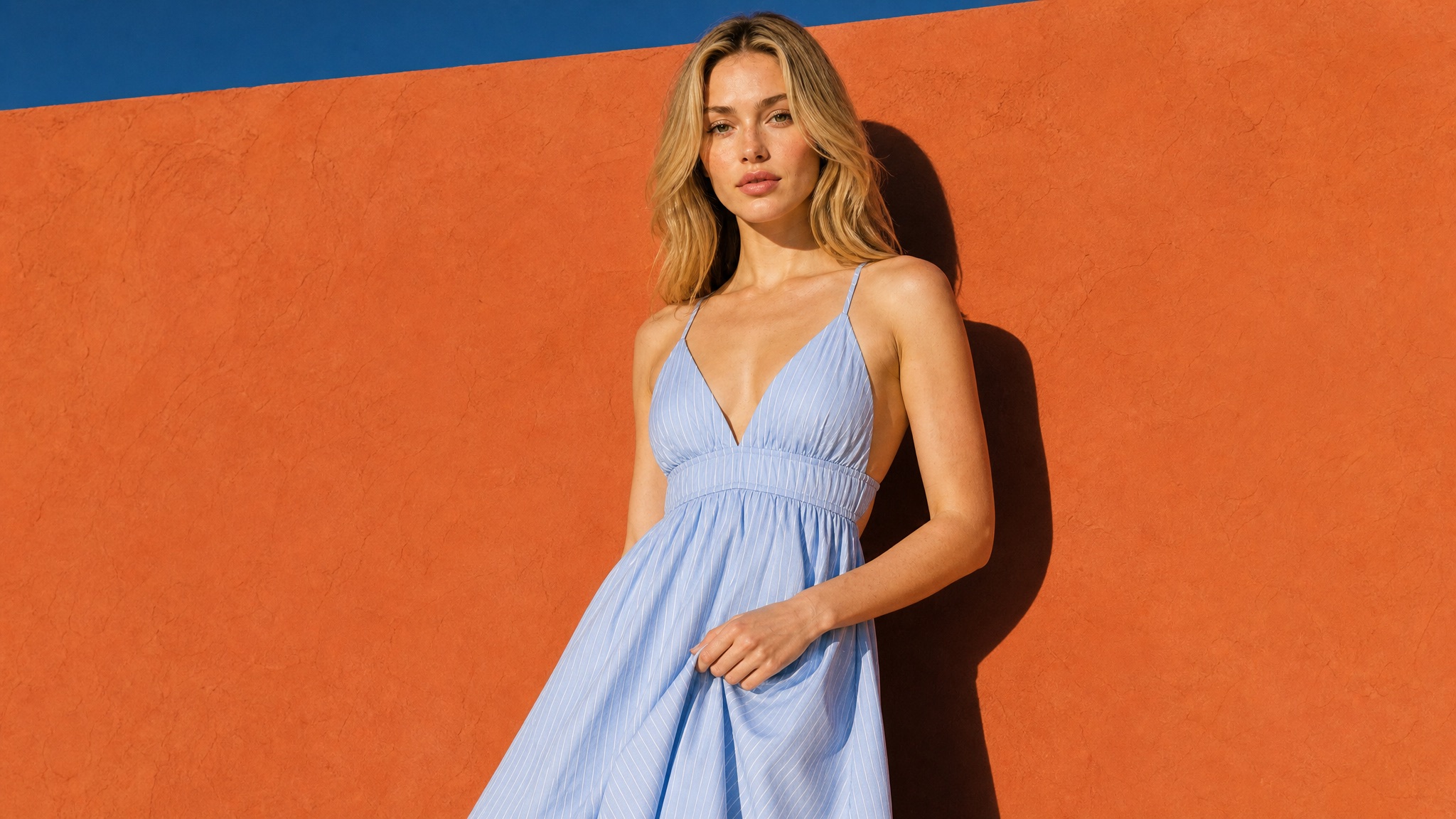
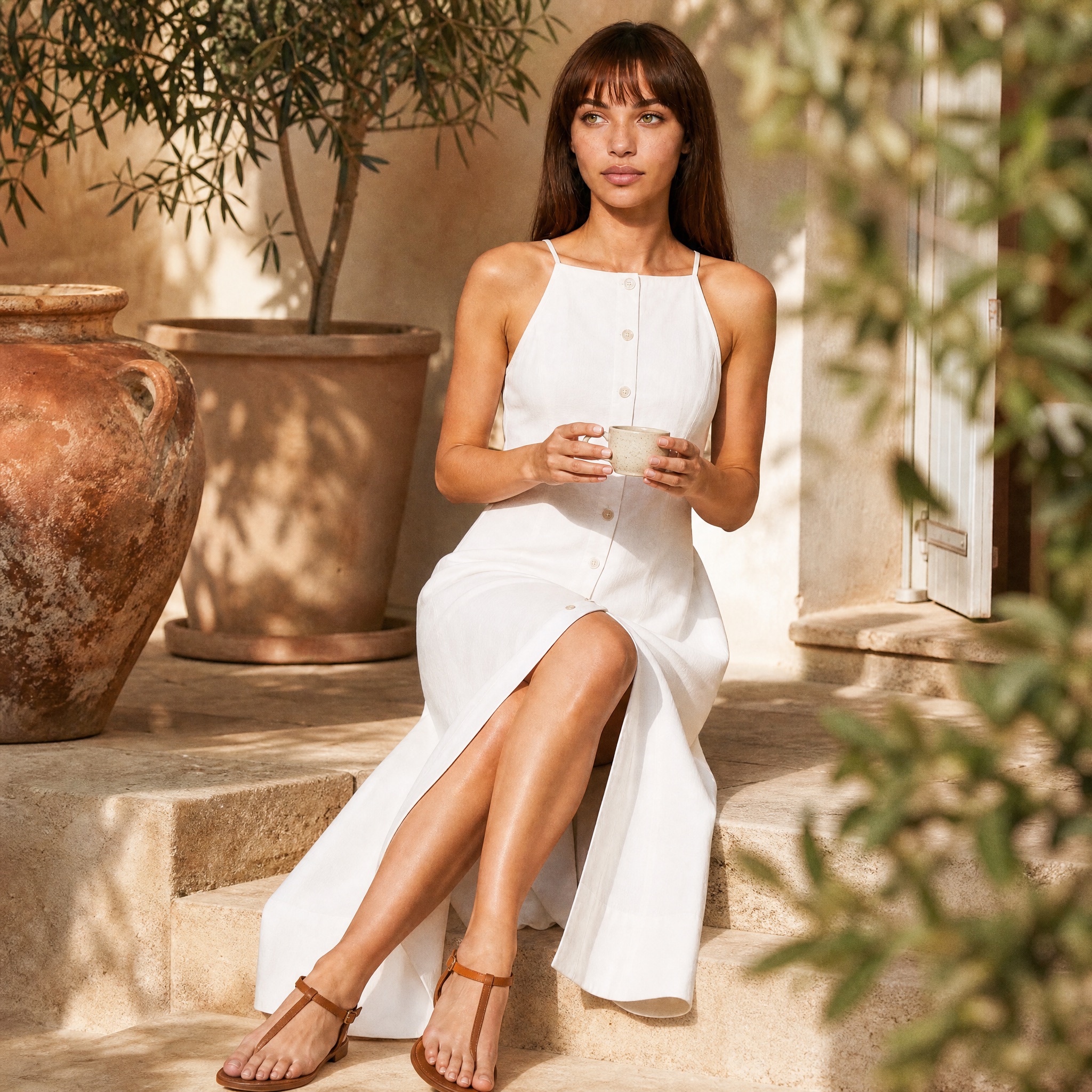
The two spec images above are what we mean by two concepts for one season: a different person, setting, light and occasion, each a separate reason to stop scrolling. A third concept would not be a new crop of either; it would be another person, place or reason to buy.
How many new ads does a scaling fashion brand need?
Meta publishes no number, so be wary of any page that quotes one as a rule. Work it out from your own account instead. List the prospecting and retargeting ad sets you want to keep running at the higher budget. Note how often Ads Manager has flagged fatigue in each over the last two months. Decide how many new concepts you want in testing at any time. The concepts you retire per month plus the ones you test is your brief.
As an illustration only: an account with three prospecting ad sets, each needing one replacement concept a fortnight, plus two concepts in testing per week, needs about 14 new concepts a month. Each concept then needs its sizes and a colorway or two, so the file count runs several times higher. Our guide to how many ad creatives you need walks through the same arithmetic in detail, and the ad creative testing framework covers how to read results per concept rather than per file.
Catalog ads are the one place where volume comes from your product feed instead of a brief. Meta's catalog accepts JPEG or PNG images of at least 500 x 500 px and up to 8 MB (Meta catalog reference, checked October 2026). A clean on-model image for every colorway feeds those ads directly, so for a clothing brand the product imagery and the ad supply are the same problem.
Where a clothing brand's ad supply can come from
| Source | Good for | Where it runs short |
|---|---|---|
| Seasonal photo shoot | Proof of fit, hero images, Amazon main images | One model and setting per day; arrives in a single batch |
| UGC creators | Try-ons, voice, honest reviews | Lighting and styling vary by creator; usage rights need managing |
| In-house designer with an AI image tool | Fast variants of styles you have shot | Every image needs checking against the sample, and the designer's time is finite |
| Ad creative agency | Statics, video and imagery at a steady cadence | Not a substitute for proof of fit; costs more than a tool |
Most brands that scale well use more than one row. They shoot what has to be a photograph, buy creator content for try-ons, and generate the settings, colorways and ad variants in between. Our comparison of AI fashion photography and a traditional shoot goes channel by channel on which images can be generated.
Generated fashion imagery has a real cost in attempts. Before Overs existed, we built four campaigns by hand in 2026 with AI image models: 361 renders for 45 usable images, about eight per keeper. Men's trousers on a model took 40 renders for 11 keepers. Surf apparel on one consistent model took 163 renders for 12, because keeping the same face and body across a set is harder than getting one good frame. Scaling a fashion account asks for exactly that consistency, so budget review time for it.
Keeping the brand recognizable at higher volume
More concepts can make an account look like several brands. The fix is to write the rules down once, before production, and check every ad against them: who your customer sees (the casting and body range), your colorways and how each must render on screen, the settings that belong to the brand and the ones that don't, how type and logo sit on a static, and the export size for each placement. Those are the items our brand intake records before the first batch.
If the new concepts use AI-generated people, plan the label. New York requires a conspicuous disclosure when an ad knowingly uses a synthetic performer, from June 9, 2026 (Cooley, January 2026, checked October 2026), and Article 50 of the EU AI Act requires disclosure of realistic AI depictions from August 2, 2026 (Davis+Gilbert summary, checked October 2026). This is general information, not legal advice.
A 30-day plan to scale without cost per purchase drifting
Week 1. Set the cost-per-customer ceiling from margin after returns. List the ads carrying most of the spend, count them as concepts using the table above, and note every fatigue flag.
Week 2. Brief four to six new concepts on fit-approved styles with depth in every core size. Make each one differ by person, setting, reason to buy or format, not by caption.
Week 3. Launch them next to the current winners. Judge results per concept, and keep budgets on what holds cost per purchase under the ceiling.
Week 4. Raise spend in steps only on ad sets that stay under the ceiling, retire what fatigued, and write the next brief from what won. Our guide to scaling ad creative production covers keeping that loop running month after month.
Which should you buy?
You have no winning ad yet. A freelance designer or your own team, testing a few concepts cheaply. Volume comes after you know what works; see creative agency vs freelancer.
Your spend is growing faster than your shoots can refresh it. An ad creative agency that makes statics, video and the imagery behind them. This is the work 100 Creatives does for apparel brands.
Your best ads are people trying clothes on. A UGC creator agency. See UGC ad creatives.
You want a flat monthly fee for design requests. An unlimited design subscription; our comparison of unlimited ad creative services lists prices checked October 2026.
You have a designer in-house and want to make variants yourself. An AI image tool. Overs is one; it is built by our founder and is a brand of the same company as 100 Creatives (2587689 Alberta Ltd.), so weigh that. Our comparison of an agency or an AI tool for product photos covers when each fits.
Where 100 Creatives fits
100 Creatives is an AI-powered creative agency in Calgary, Canada, that makes static and video ads, and the product imagery behind them, for DTC and consumer brands advertising on Meta, TikTok and Google. We make our campaign and product images with Overs today. Most of our client work is under NDA, so the portfolio shows spec work: concepts made for brands that did not commission them.
Send your current top ads, the styles you want to scale, which of them are fit-approved and in stock, and your cost-per-customer target. If a style needs a real shoot or your account needs testing before volume, we will say so before we quote. Pricing lists the starting points.