The quick answer
Pick 100 Creatives if you sell sleepwear, pajamas or loungewear direct, you already have real photos of each set on a person, and you need gift-season ads in every Meta, TikTok and Google size faster than another shoot can deliver them.
- Static and video ad creative is quoted in written budget ranges that start at $4,000, as a fixed total, and nothing is charged until you approve the quote.
- Apparel imagery starts at $10,000 per 100-SKU programme, which covers a print run across a family set's adult, kid and baby sizes.
- Creative batches come back in 48 hours, and revisions within 48 hours, so a holiday calendar has room for a second round.
- A brand intake before production records visual language, model preferences, colorways and export specs. For sleepwear we add the fiber name on each label and which kids' sizes are sold as tight-fitting.
Pick something else if you need the photos that prove a children's set fits (book a kids' photographer and shoot the real garments in the labeled sizes), your sets haven't been tested or labeled yet (talk to a product-safety consultant or testing lab first), or the campaign is one hero family portrait for a catalog cover (a family-lifestyle photographer is the better buy).
An earlier version of this page priced a family-lifestyle shoot at $55,000 to $110,000, sold a "fabric-hand-and-family-multiple contract" at $18,000 to $38,000 with per-frame prices from $70 to $160, told a story about a "$7M sleepwear brand", gave revenue figures for named sleepwear brands, credited a returns finding to a consultancy without a link, and captioned spec images of a sundress as sleepwear frames. None of that had a source, and 100 Creatives does not sell that contract. This version removes all of it and covers the rules that shape sleepwear imagery, with each outside fact linked.
What makes sleepwear imagery different from other apparel
Most apparel campaigns have to show the garment, the fit and a mood. Sleepwear has to do that inside three rules that come from outside the brand.
Product safety. Children's pajamas in the US are regulated for flammability, and most cotton and bamboo-rayon kids' sets are sold legally by being cut close to the body. The photo has to agree with that cut.
Fiber names. Sleepwear sells on touch, so ads name the fabric: modal, bamboo, silk, organic cotton. The FTC has rules on what you may call a fiber, and it has fined retailers over the word "bamboo".
Platform review. The setting is a bed, the clothes are light and sometimes sheer, and the models are close to the camera. Meta's ad standards treat some of those frames as adult content, which narrows who sees them.
Then there is the calendar. Matching family sets and gift sets are bought as presents, so most brands need their best ads live before the holiday rush, with a separate set for the last days of shipping. The sections below take the three rules one at a time, then the family-set problem, then the plan.
Kids' pajamas: the fit in the photo has to match the hangtag
US children's sleepwear flammability rules cover garments sized above 9 months up to size 14, under 16 CFR parts 1615 and 1616 (CPSC fact sheet, checked October 2026). CPSC staff say that children's sleepwear made from certain untreated fibers, including 100% cotton, 100% silk, 100% rayon and 100% modal, typically fails the flammability test (CPSC children's sleepwear FAQ, checked October 2026). That list covers the fabrics pajama brands most often name in their ads.
The usual way such sets are sold legally is the tight-fitting exemption: the garment stays under maximum chest, waist, seat, arm and leg dimensions, with tapered sleeves and legs, and carries a hangtag. The regulation sets the hangtag text: "For child's safety, garment should fit snugly. This garment is not flame resistant," followed by "Loose-fitting garment is more likely to catch fire" (16 CFR 1615.1, eCFR, checked October 2026). Garments for babies 9 months and under are exempt if they meet length limits and are labeled by age in months.
Two more points from CPSC matter for a campaign. Whether a garment counts as sleepwear depends partly on how it is promoted, and retailers are told not to promote garments that don't meet the standard in a way that leads shoppers to see them as children's sleepwear. And CPSC staff treat children's "loungewear" as sleepwear, while sweatshirts, sweatpants and athletic leggings are generally daywear.
Our reading for imagery, which is not legal advice: if a kids' set is sold as tight-fitting, every photo and ad should show it snug, on a child wearing the labeled size. Sizing a child up for a relaxed, slouchy look puts a picture next to the hangtag that says the opposite. Keep daywear such as a kids' sweatsuit out of bedtime scenes unless it is tested and labeled as sleepwear. And photograph children's fit frames on the real garment; a generated child's fit proves nothing about the actual cut. Ask whoever handles your product compliance to sign off on the kids' frames before they run.
Fiber claims in ads: "bamboo" is usually rayon
In April 2022 the FTC sought $2.5 million from Kohl's and $3 million from Walmart for marketing rayon textiles as bamboo in product titles and descriptions, which the FTC called by far the largest penalties in this area (FTC press release, April 2022, checked October 2026). The FTC's guidance says a product that uses bamboo only as the plant source should be labeled and advertised with the proper generic fiber name, such as "rayon made from bamboo", and that claims about the plant's environmental or antimicrobial traits carrying over to the fabric need competent and reliable evidence (FTC, How to Avoid Bamboozling Your Customers, checked October 2026).
Sleepwear ads lean on the fabric more than most, so this reaches into the creative. A headline that says "bamboo pajamas" over an image of a bamboo grove makes a claim the label probably can't support. Write the fiber the way the care label does, put the plant story in the body copy only if you can back it, and keep the same wording in every size of the ad so a resize doesn't drop the qualifier.
The image has its own fiber job. Shoppers can't touch a modal set through a phone, so the photos have to show drape, weight and sheen: a sleeve falling over a hand, a waistband stretched, light raking across the knit. Shoot those close-ups on the real fabric. AI image models are good at "soft fabric" in general and poor at a specific fabric's weight and texture, and a close-up that makes a thin jersey look like a heavy one is the kind of picture that comes back as a return.
Bedroom shots and Meta's adult content rules
Meta's ad standard on adult nudity and sexual activity (change log dated May 14, 2025) bans nudity, including nudity covered only by a digital overlay, and sexually suggestive activity. It also lists content that should be targeted to people over 18: imagery focused on individual body parts such as the groin, buttocks or breasts, and people in sexually suggestive poses, revealing clothing, or stripping (Meta Transparency Center, checked October 2026).
Adult sleepwear sits close to that line by nature. A silk slip in bed, an unbuttoned shirt, a sheer robe, a crop toward the hips: each one can tip a frame into the 18+ group, and an ad that only reaches adults is fine for a slip but wrong for a family set that parents and grandparents are meant to see. Decide which frames are 18+ before production, brief the rest with neutral poses (reading, making coffee, sitting on the end of the bed), and never combine children and adult revealing frames in the same ad or carousel.
Generated imagery adds a quiet risk here. Image models often pull "model in pajamas in bed" toward more skin and a more posed look than the brief asked for. Review every bedroom frame for crop, neckline and pose as well as for product accuracy. Our guide to static ads for Meta covers sizes and safe zones for each placement.
Which sleepwear frames need a real shoot, and which can be generated
| Frame | Where it runs | Real shoot or generated |
|---|---|---|
| Each kids' set on a child in the labeled size | Product pages, kids' ads | Real shoot. It shows the snug fit the hangtag requires, and generated children prove nothing about the real cut |
| Fabric close-ups: drape, stretch, sheen, print scale | Product pages, fabric-led ads | Real shoot on the actual fabric |
| Adult sets on a person, front and back | Product pages, Shopify, marketplaces | Real shoot, so every later image can be checked against it |
| The gift box, folded set and packaging | Gift ads, email | Real shoot of the real box, then reused across scenes |
| Adult sets in more rooms, light and seasons | Meta, TikTok and Google ads | Generated from the approved photos, then reviewed for fit, fiber look and pose |
| Placement sizes and holiday versions (shipping cut-off, last sizes, restock) | All ad accounts, email | Generated or recut from approved images |
The split is the same one we use for any apparel brand, with two extra rules for sleepwear: children are photographed, not generated, and fabric is photographed, not described. Our page on when you need a real photo shoot covers the general case, and AI fashion models vs real models goes through consent and likeness.
Matching family sets: one print, five bodies
A matching family set is one print sold in baby, kid and adult sizes, and the ad has to show all of them as one story. That creates a consistency problem a single-size garment doesn't have. The print repeat has to sit at the right scale on a newborn and on an adult XL. The trim color has to match across sizes. And the adults in the frame have to look like the same family across every ad in the campaign.
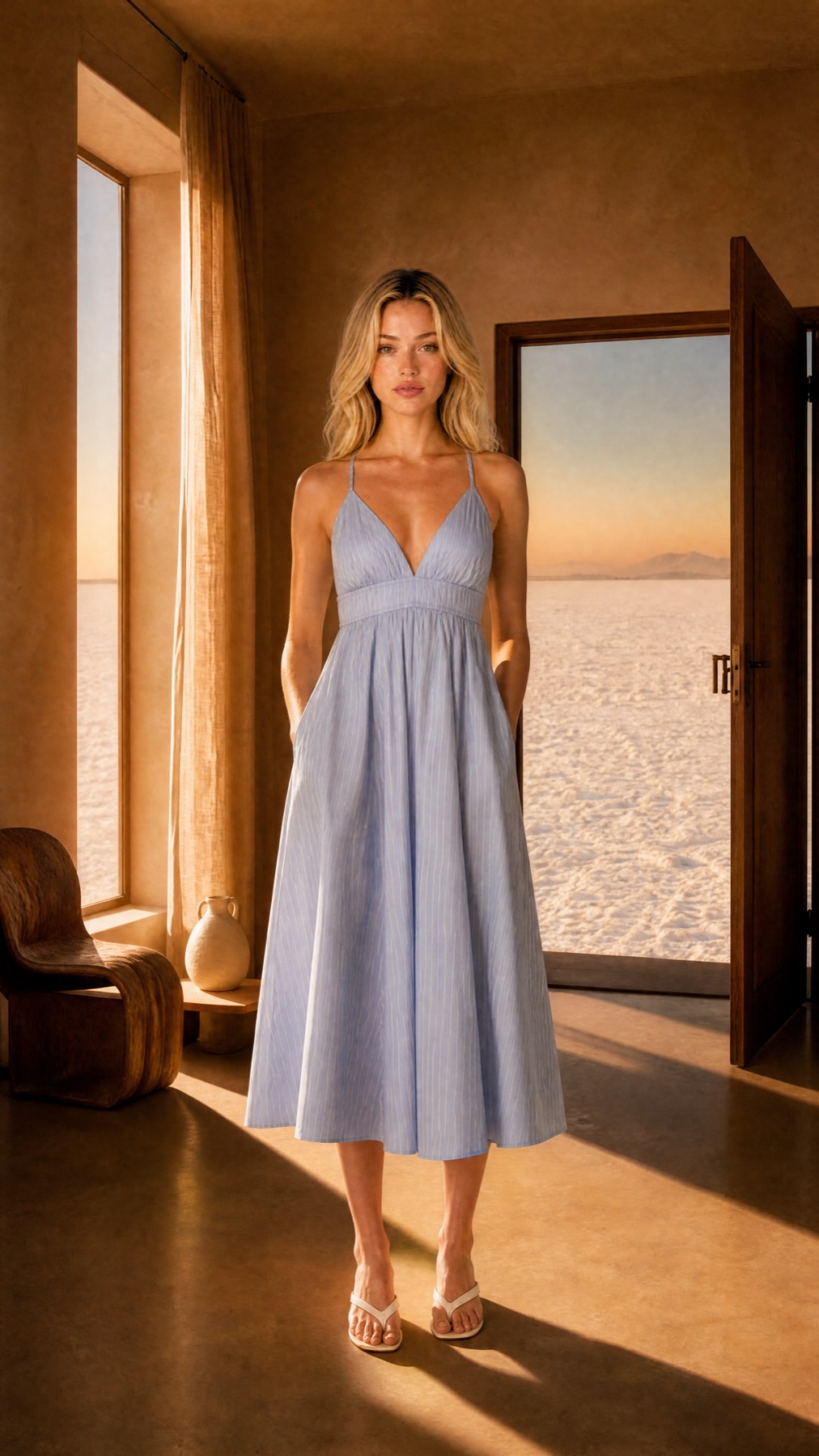
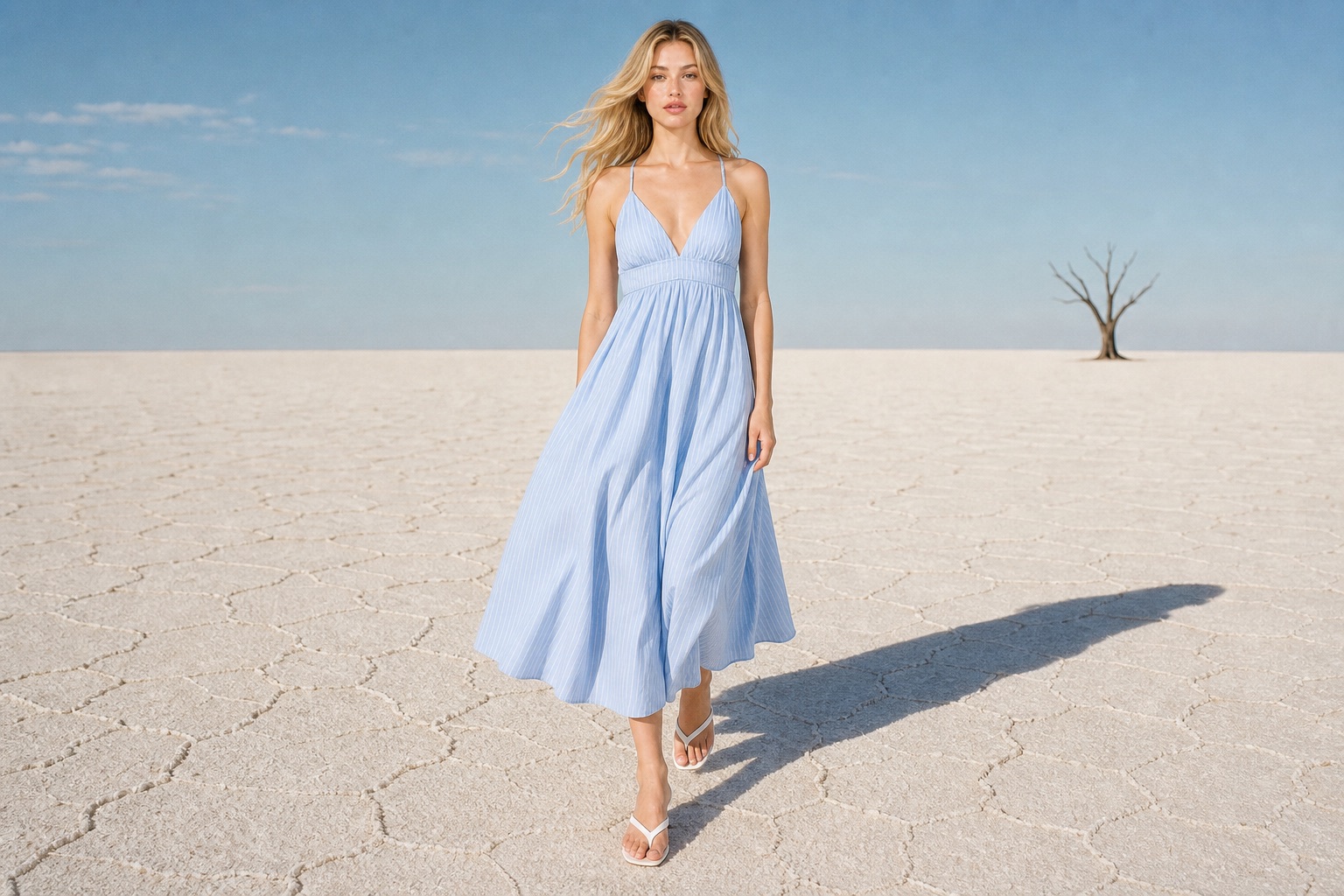
These two spec images are not sleepwear; our portfolio has no sleepwear spec piece, and most of our client work is under NDA. They show the check a sleepwear set needs between a close interior frame and a wide one: the stripe runs the same direction, the strap width holds, the hem lands in the same place, and the person is recognizably the same. For a pajama print, add the repeat scale and the piping color, and compare every frame with the physical sample rather than with the best-looking render.
Expect to throw most attempts away. Before Overs existed, we built four campaigns by hand in 2026 with AI image models: 361 renders for 45 usable images, about eight per keeper. Holding one person and one garment steady was the hardest part; surf apparel on one consistent model took 163 renders for 12 keepers, and men's trousers on a model took 40 for 11. Today we make our campaign and product images with Overs, an image tool built by our founder and owned by the same company as 100 Creatives (2587689 Alberta Ltd.). Our checklist for reviewing AI creative from an agency lists what to check frame by frame.
If any generated adult in the family frames is a realistic person who doesn't exist, plan the disclosure before the ads run. New York requires a conspicuous disclosure when an ad knowingly uses a synthetic performer, from June 9, 2026 (Cooley, January 2026, checked October 2026), and Article 50 of the EU AI Act requires disclosure of realistic AI depictions from August 2, 2026 (Davis+Gilbert, checked October 2026).
A gift-season plan, working back from the shipping cut-off
This is the order we work in. It is our plan, not an industry standard, and the dates depend on your own carrier cut-offs and how long your team takes to review.
Before any image. Confirm which kids' sizes are sold as tight-fitting, the exact fiber wording on each care label, and which adult frames you are willing to run as 18+. Complete the brand intake: visual language, model preferences, colorways and export specs.
The shoot. Kids' sets on children in the labeled sizes, adult sets front and back, fabric close-ups, the gift box. If you have last year's approved photos of a carried-over print, list them so they aren't shot twice.
The first ad set. A small set of concepts that differ by reason to buy: the gift, the fabric, the matching family, the self-purchase. The review settles direction before volume. Our guide on how to brief an agency for AI creative lists what to send.
Launch. Finished ads in every placement size, submitted early enough to clear ad review, with the fiber wording identical in every size.
The last stretch. Shipping cut-off, gift card and last-sizes versions, made ahead and switched on as dates pass. For how many ads a season like this needs, see how many ad creatives you need.
Which should you buy?
You need to prove the kids' sets fit. A photographer who shoots children, with the real garments in the labeled sizes, a guardian on set and the image rights in writing. No generated imagery replaces this.
Your sets aren't tested or labeled yet. A testing lab or product-safety consultant before any campaign. The rules above decide what you can sell, and the imagery follows from that.
You want one hero family portrait for a catalog or press. A family-lifestyle photographer. One great frame is their job.
You have the photos and need gift-season ads in every size. An ad creative agency that makes statics, video and the imagery behind them. This is the work 100 Creatives does for apparel brands.
The sets sell on unboxing and try-on reactions. A UGC creator agency. See UGC ad creatives for what that buys.
You have a designer in-house and want to make adult variants yourself. An AI image tool. Overs is one; it is built by our founder and is a brand of the same company as 100 Creatives, so weigh that.
Where 100 Creatives fits
100 Creatives is an AI-powered creative agency in Calgary, Canada, that makes static and video ads, and the product imagery behind them, for DTC and consumer brands advertising on Meta, TikTok and Google. Most of our client work is under NDA, so the portfolio shows spec work: concepts made for brands that did not commission them.
For a sleepwear brand, send the line list with fiber wording from each care label, the kids' sizes sold as tight-fitting, your approved product photos and your shipping cut-off dates. If a frame needs a real child, real fabric or a real gift box, we will say so before we quote. Pricing lists the starting points.